Federal Budgets are often judged by the programs they announce and the systems they promise to reform. For communities under pressure, the more urgent question is who carries the need that remains.
The 2026–27 Federal Budget, handed down by Jim Chalmers for the Albanese Labor Government, assumes that major social systems can be reformed, costs can be contained and new supports can be built while people continue to find help somewhere else. In practice, that “somewhere” is often a grassroots organisation: a small charity, local service, community-led program or social enterprise already working close to people experiencing poverty, housing stress, disability, family violence, exclusion or disconnection.
At The Funding Network, we see the same pattern across Australia. When public systems tighten, transition or fail to reach people early, grassroots organisations absorb the impact. They help families navigate services, support young people before crisis escalates, create trusted pathways into community and provide practical care where formal systems are hard to access.
The biggest risk in this Budget is that already-stretched community organisations are once again expected to do more with less.
The Budget contains welcome investment across health, aged care, First Nations communities, children and families, including Thriving Kids, the first phase of a new system of supports outside the NDIS for children aged eight and under with developmental delay and/or autism with low to moderate support needs. At the same time, the Government expects NDIS reforms to save $37.8 billion over four years.
That tension sits at the heart of the sector’s concern. The Institute of Community Directors Australia captured the sector’s response as one of cautious optimism, mixed with serious concern. Its Budget overview made clear that the gaps are substantial: people on the lowest incomes received little direct relief, housing and homelessness prevention investment remains insufficient, and projected NDIS cuts are deeply concerning.
Australian Council of Social Service (ACOSS ) CEO Dr Cassandra Goldie welcomed some reforms in the Budget, including migrant skills recognition, child support measures and funding to help 4,000 young people access community housing. But she warned that tax cuts will not help those with the least, noting that people on lower incomes are already “skipping meals, delaying medical care and rationing energy”, while many people with disability are “alarmed and fearful” about what major NDIS cuts could mean for them.
Housing and homelessness leaders are raising the same issue in a different form: without prevention, crisis lands somewhere else. Mission Australia has welcomed funding for the youth housing supplement, but CEO Sharon Callister argued that the Budget did not go far enough to address cost-of-living pressure, housing stress and homelessness prevention.
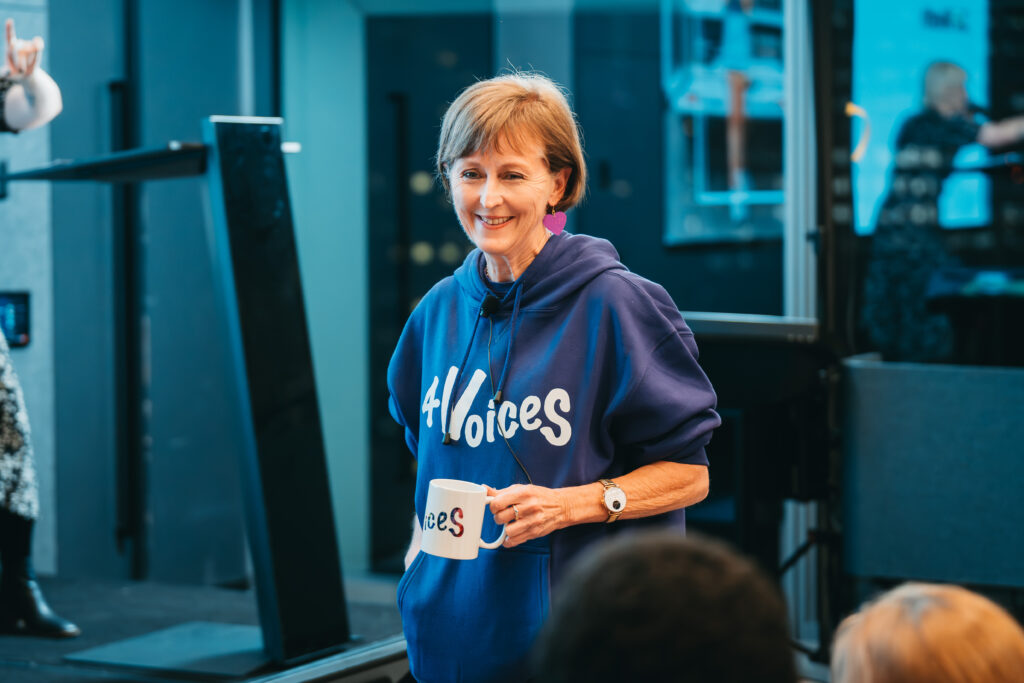
Jo Westh from 4Voices pitches at Equity & Inclusion, Sydney 2023
These responses point to the same underlying problem: when people cannot access support early, they do not stop needing help; they simply arrive somewhere else. Grassroots organisations are often first to see the consequences of policy change. They see the young person couch surfing before homelessness becomes visible. They see the parents struggling to understand a new support system. They see the person with disability who needs connection, transport, work, advocacy or confidence to participate. They see the family whose cost-of-living pressure has become a crisis. TFN exists because those organisations are in desperate need of flexible funding, practical capability-building, visibility, pro bono support and networks that continue beyond a single grant.
As Australia’s largest collective giving movement, TFN sits between grassroots organisations and the people with the resources, influence and skills to back them. Our four impact areas – First Nations, Thriving Young People, Equity & Inclusion and Local Communities – are also the areas where many of this Budget’s pressures will be felt most directly: in disability inclusion, youth wellbeing, housing stress, community connection, First Nations-led solutions and local responses to poverty and exclusion.
Our role is to help support flow more effectively to the organisations closest to the work. We identify and vet high-potential grassroots non-profits and social enterprises, help leaders strengthen their storytelling, and connect them with businesses, philanthropists and everyday Australians through collective giving. That model helps move flexible capital and practical support to community-led organisations at moments when they are ready to deepen or grow their impact.
This is the practical space between national policy and lived experience. Government has a responsibility to build fair, accessible and adequately funded systems, but reform only works when people can access support in real life, at the point they need it, in communities they trust. Through TFN, the wider community of businesses, philanthropists and everyday Australians can back carefully vetted grassroots organisations without having to guess where support is most needed. They can contribute funding, offer skills, open networks and stand behind the local leaders already doing the work.
The 2026-2027 Budget confirms that Australia is entering another period of system change. NDIS reforms will reshape access to disability supports, housing stress will continue pushing people toward crisis and cost-of-living pressure will keep affecting people who receive little direct relief. Grassroots organisations will carry much of that transition. TFN’s view is clear: they should not have to carry it alone.
Want to back grassroots organisations doing the work in communities across Australia? Join us at an upcoming TFN event and be part of collective giving in action.